
Affiliate Disclosure: This article contains affiliate links. We may earn a commission at no extra cost to you
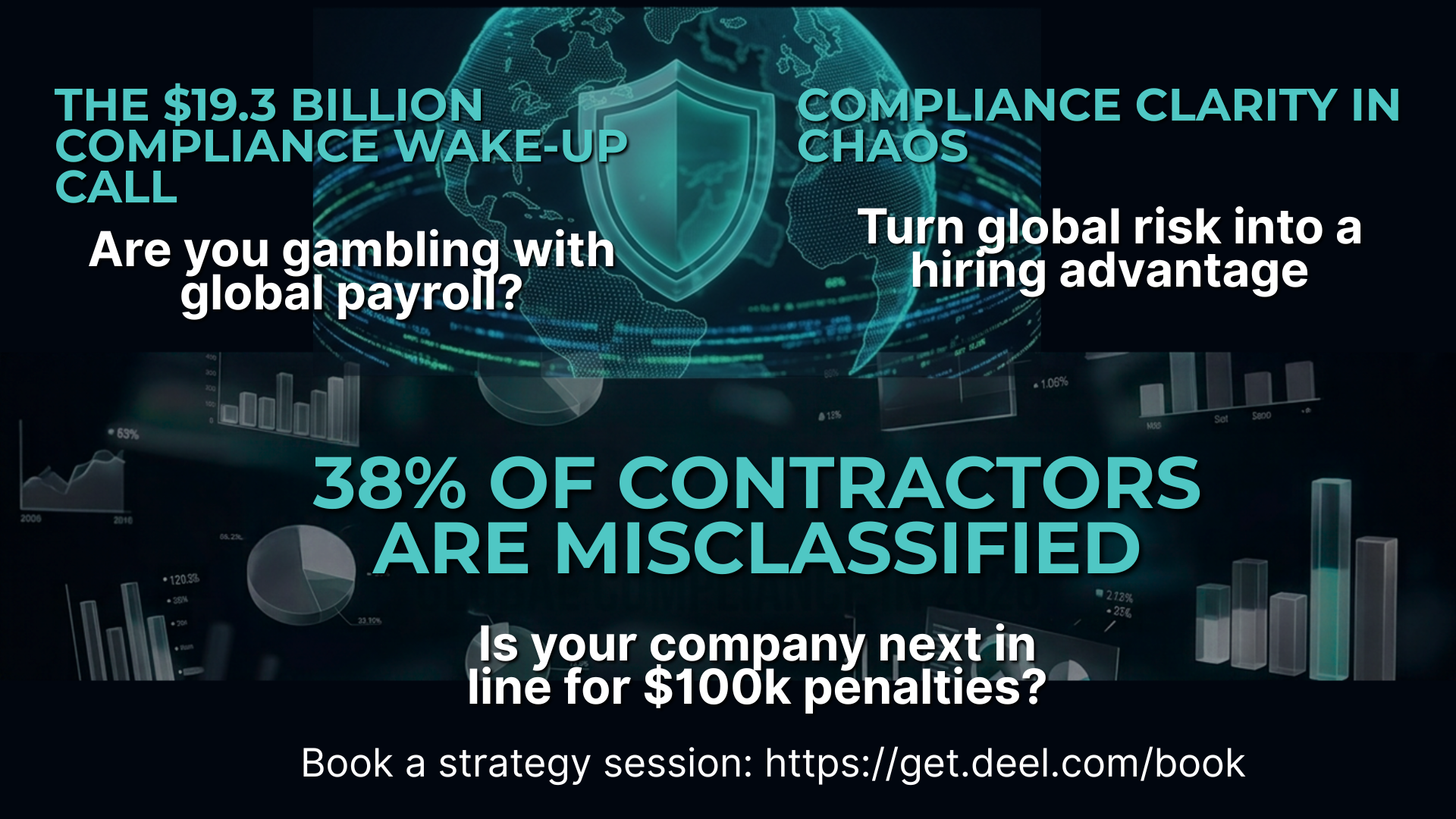
How a new era of digital-first enforcement is turning “business as usual” into a major financial liability and the strategy HR leaders need to survive it.
The Compliance Confidence Trap
There is a dangerous gap between perception and reality in global HR. While 98% of HR leaders believe they understand the employment laws in their operating jurisdictions, nearly three out of four (74%) have already been hit with costly international compliance challenges. This discrepancy is no longer just an administrative headache; it is a $19 billion pothole that is quickly becoming the single largest business risk for global companies in 2026.
The complexity of managing a global workforce is increasing at an unprecedented rate. According to the 2025 Global Payroll Complexity Index, average complexity scores rose by 5% in just two years. As baseline expectations for payroll and HR teams grow, many organizations find themselves using 20th-century manual processes to solve 21st-century regulatory problems
The Three Compliance Traps That Are Sinking Global Companies
Trap 1: Worker Misclassification The $100,000-Per-Worker Liability
Misclassification is one of the most common and expensive global payroll mistakes, with roughly 10% to 30% of employers misclassifying employees as independent contractors.
The penalties are staggering:
| Jurisdiction | Penalty Type | Potential Cost |
|---|---|---|
| Germany | Retroactive social security | ~40% of monthly remuneration, backdated up to 30 years + 12% annual interest |
| Germany | Intentional tax evasion fines | Up to EUR 10 million |
| EU | Severe misclassification cases | Up to 4% of global turnover |
| Various | Per-worker penalties | $100,000+ per misclassified worker in high-compliance regions |
| Australia | Company fines | Up to AUD 82,500 |
| UK | Unpaid pension, holiday pay, NI | £18,000–£30,000 |
What’s driving the crackdown? In 2025, the U.S. Department of Labor and the EU’s Platform Work Directive aggressively narrowed the definition of an “independent contractor.” What you called a contractor in January may have been legally classified as a full-time employee by June triggering retroactive taxes, social security payments, and massive fines.
The EU Platform Work Directive, fully implemented across member states as of July 2025, introduced a rebuttable legal presumption of employment for platform workers shifting the burden of proof to employers to demonstrate that a worker is genuinely independent.
📊 Data Point: A 2023 IRS audit report found that 38% of contractors were misclassified, leading to an estimated $3.4 billion loss in U.S. tax revenue.
Trap 2: Global Payroll Complexity When One Mistake Compounds Across Borders
Managing payroll across multiple countries means tracking an ever-growing set of jurisdiction-specific tax codes, filing deadlines, and mandatory benefits. In 2026, the stakes are higher than ever:
- Digital reporting mandates are expanding. Countries across Europe, Latin America, and Asia are requiring real-time or near-real-time payroll reporting to tax authorities.
- Over 30 countries updated payroll, employment tax, or mandatory benefits rules between 2025 and 2026.
- 85% of compliance professionals report that regulatory complexity has increased significantly in the last 12 months.
The shadow payroll trap: A sales director spending three months in France “working remotely” can accidentally trigger a permanent establishment risk, making your entire company liable for French corporate tax. 49% of global companies have already faced penalties because of shadow payroll risks.
In a 2025 PayrollOrg survey, 57% of respondents said local compliance was their biggest global payroll challenge.
Trap 3: The Confidence Gap Overestimating Knowledge, Underestimating Risk
The disconnect between confidence and reality is staggering:
- 62% of UK HR leaders reported being “very confident” about their legal knowledge yet 75% of UK firms reported compliance issues abroad.
- The problem is particularly acute in Europe, with over 80% of French and German firms reporting compliance problems, significantly higher than in the US (57%).
- 42% of HR executives are using four or more HR tools to manage their global workforce creating fragmentation that amplifies risk.
Confidence alone is not a compliance strategy.
The Regulatory Tectonic Shift: What’s Changing in 2026
The compliance landscape isn’t just getting more complex it’s fundamentally restructuring:
| Regulation | Impact | Timeline |
|---|---|---|
| EU Platform Workers Directive | Rebuttable presumption of employment; forces reclassification of gig workers | Fully implemented July 2025 |
| EU Pay Transparency Directive | Gender pay gap reporting for 100+ employee companies; salary ranges in job postings | Transposition deadline June 7, 2026 |
| Australia | Intentional underpayment of wages becomes criminal offense | January 1, 2025 |
| Global AI Regulation | AI adoption accelerating faster than regulation shifting risk to employers | |
| Enforcement Focus | “In 2026, the employment law focus is shifting away from new legislation and towards how rigorously existing rules are enforced” |
The bottom line: Employment risk is becoming more complex, more localized, and more visible
The EOR Advantage: How Engagement Models Impact Compliance Risk
Research from 2025 Global Workforce Report: Lean HR, global scale & intentional AI | Remote Report (surveying 3,650 HR and business leaders across 10 countries) reveals a clear pattern: how you engage international workers dramatically affects your compliance risk:
| Engagement Model | Firms Reporting Compliance Issues |
|---|---|
| Local Entity | 52% |
| Contractors | 51% |
| Employer of Record (EOR) | 40% |
The data is compelling: companies using an Employer of Record (EOR) model report significantly fewer compliance issues. The reason is straightforward EOR offloads the complexity of local payroll, tax, and labor law compliance to an expert third party, dramatically reducing organizational risk.
How Deel Turns Compliance from a Liability into a Competitive Advantage
This is where the solution comes into focus. Deel has built the world’s most comprehensive global compliance platform trusted by 40,000+ companies from startups to enterprise.
1. Continuous Compliance™ Always-On, Always-Updated

Deel’s Continuous Compliance is an always-on approach that applies local rules automatically across payroll, hiring, and contractor workflows. The platform:
- Captures regulatory updates like wage rules, tax updates, and employment requirements as they happen
- Checks worker data against country-specific rules across payroll, contracts, and employment status
- Flags risks early with notifications when changes to laws and regulations occur saving you from hefty fines and headaches
🔍 Key Feature: Deel centralizes compliance signals across EOR, contractor management, payroll, and direct employment not just information, but actionable insights.
2. AI-Powered Worker Classification
Deel’s AI-powered Worker Classifier developed in partnership with Queen’s University assesses classification risk using localized models trained on hundreds of employment court cases.
How it works: Answer a few questions on the platform, and the tool identifies the worker’s classification using relevant local laws and precedent legal cases. You can assess (and re-assess) worker classification at any time at onboarding and throughout the contract.
3. Deel Contractor of Record (COR) Zero Misclassification Risk
For organizations seeking to eliminate misclassification liability entirely, Deel Contractor of Record legally hires contractors on the client’s behalf and assumes total liability in the event of misclassification claims.
- Zero misclassification legal risk: Deel is the hiring body, responsible for classification
- Rapid onboarding: Up to 7 days to hire compliantly
- Full indemnification: Deel is fully liable should any misclassification cases arise
4. The Knowledge Hub: The World’s Largest Compliance Library

- Review regulatory updates as they happen
- See flagged risks across their entire workforce
- Understand why something changed and what to do next
5. Global Payroll with Built-In Compliance
- Local rules, filings, and statutory requirements apply automatically before payroll runs
- Choose self-serve or managed payroll by country mix models as your business scales
- 60% less time processing payroll and 75% fewer payroll employee queries (Forrester TEI™)
6. Enterprise-Grade Security and Integration
The Bottom Line: Compliance as Strategy
- $19.3 billion in global regulatory fines in 2024
- $42,000 per compliance incident
- 74% of companies have faced international compliance challenges
- 38% of contractors misclassified, costing $3.4 billion in lost tax revenue
- 57% of compliance professionals say regulatory complexity has “increased significantly”
- Hire anyone, anywhere with confidence
- Pay in 200+ currencies with built-in compliance
- Manage global payroll in one unified system
- Eliminate misclassification risk through AI-powered classification and Contractor of Record
- Stay ahead of regulatory changes with Continuous Compliance
Ready to Turn Compliance into Your Competitive Edge?
Disclaimer: This article is for informational purposes only and does not constitute legal, tax, or accounting advice